Reach for a moisturizer when skin feels dry, and it will genuinely help, temporarily. But the deeper question is why skin loses its ability to hold moisture in the first place, and why our skin gets much drier in perimenopause and menopause. That answer has almost nothing to do with what’s happening on the surface.
The Mechanism: How Dermis Collagen Holds Skin's Water
Moisture in skin isn’t just sitting there. It’s bound in place by a network of molecules living in the dermis, the layer where collagen really lives, primarily proteoglycans and hyaluronic acid, both of which are structurally dependent on the collagen matrix that surrounds them. ¹ Collagen fibers create the physical scaffolding that holds these water-binding molecules in position, allowing them to do their job of attracting and retaining moisture within the tissue.
When that collagen scaffolding is dense and well organized, the dermis holds water efficiently. When collagen thins or becomes disorganized, as it does with age and especially after menopause, this water-holding structure breaks down too, and skin loses hydration capacity even if nothing about the moisturizing routine has changed.
Estrogen, Collagen, and What Causes Skin Aging in Perimenopause
Estrogen influences this system directly. Research has found that estrogen encourages the production of hyaluronic acid in skin, which is part of why hydration and elasticity tend to decline together during perimenopause and after menopause rather than as separate, unrelated changes. ² As estrogen drops, both the collagen scaffolding and the moisture-holding molecules it supports lose ground at the same time.
Why Moisturizer Can't Reach Dermis Collagen
Topical moisturizers work primarily on the epidermis, the outer, non-living layer of skin, where they can temporarily reduce water loss from the surface. This is genuinely useful, and it’s not a reason to skip moisturizer. But it doesn’t address the deeper issue: a dermis that has lost the structural capacity to hold water on its own. A moisturizer manages symptoms at the surface. It doesn’t rebuild the collagen network responsible for hydration underneath it, the same scaffolding that makes elasticity possible in the first place.
What Research Says About Collagen Peptides and Skin Hydration
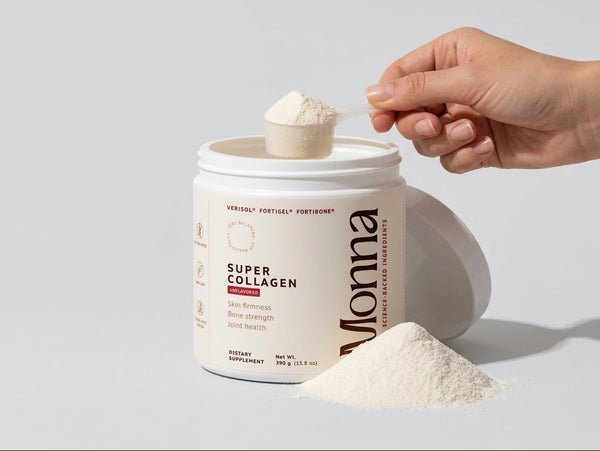
Because hydration is downstream of collagen structure, research on oral collagen peptides has measured hydration directly, instead of just looking at wrinkles or elasticity. In a randomized, placebo-controlled trial, women taking a specific bioactive collagen peptide daily for 8 weeks saw a hydration increase of roughly 26% compared to placebo, measured with a device that assesses skin’s water content directly. ³ This is a meaningful finding, because it suggests the peptide is influencing the dermis’ actual water-holding capacity, not simply adding moisture from the outside.
Collagen Peptides for Skin Elasticity, Hydration, and Firmness
Hydration, elasticity, and firmness are often talked about as three separate skin concerns, but they all trace back to the same structure: a well-maintained collagen network in the dermis, the true engine behind what skin does, looks and feels. Supporting that structure from within, alongside a good moisturizing routine is the more complete way to think about skin hydration as we move through our 40s, 50s, and beyond.