

What Happens to Our Collagen During Menopause
Collagen is the structural protein that makes up close to a quarter of all the protein in the human body, forming the framework of our skin, bone, cartilage, tendons, and ligaments. During our reproductive years, collagen production and breakdown stay fairly balanced, largely thanks to estrogen. During the menopause transition, that balance shifts: production slows, breakdown speeds up, and the result is a real, growing collagen shortfall.
This isn’t a small or slow change. Research tracking skin collagen directly has found that women lose close to 30% of their skin collagen in the first five years after menopause, with continued losses of about 2.1% a year for at least a decade after that. ¹ That’s a much faster rate of loss than the roughly 1 to 1.5% a year linked to ordinary aging in the years before menopause. ²
Why Losing Estrogen Leads to Losing Collagen
The reason behind this is well understood. Estrogen receptors sit directly on the fibroblasts that build our skin collagen, the cells that build our bones, and cells throughout our cartilage and connective tissue. ³ In lab studies, estrogen has been shown to increase collagen production in skin cells while also slowing down the enzymes that break collagen apart. ⁴ In effect, estrogen tells our collagen-building cells to keep working, and tells the enzymes that break collagen down to hold back.
When estrogen drops sharply during menopause, both sides of that message weaken at once. Our cells make less new collagen. What collagen we do have breaks down faster, without enough new collagen being made to replace it. The result is a loss that shows up across every part of the body that depends on collagen for strength and stretch — not just one area, but all of them, together.
Skin: The Part of Collagen Loss We Can See
Skin is where collagen loss becomes visible first, because the dermis — the collagen-rich layer just beneath the surface — is easy to notice. As that layer thins and becomes less organized, skin loses firmness, elasticity, and its ability to hold moisture, and fine lines and sagging become more noticeable. ⁵ Studies measuring skin thickness in postmenopausal women have found yearly reductions of about 1.1%, on top of that 2.1% yearly collagen loss, adding up over time.
This is often the point where many of us reach for skincare as a first response, which makes sense — but it only goes so far, since topical products mainly work on the skin’s outer, non-living layer and can’t restore the internal estrogen signal driving the loss underneath. If you want to understand that difference more, we’ve written more on why healthy aging should start with structural health, not skincare.
Bone: The Loss We Can’t See Coming
Bone tells a similar story, but with far less warning. Close to 90% of bone’s organic material is type I collagen, forming the scaffold that mineral crystals attach to and giving bone the flexibility it needs to resist breaking, separate from mineral density alone. ⁶ As estrogen drops, bone remodeling shifts toward breaking down faster than it rebuilds — a process that can continue quietly for years before it ever shows up on a bone density scan.
The research on this is pretty strong. In a 12-month study of 131 postmenopausal women with age-related bone loss, the women taking 5 grams of specific collagen peptides daily saw real, measurable increases in bone density at the spine and hip, along with rising levels of a bone-building marker called P1NP — while the group on a placebo kept losing bone density over the same period. ⁷ A longer follow-up of these same women found their bone density kept improving over four years of continued use. ⁸
Joints & Connective Tissue: Why Everything Can Feel Stiffer
Cartilage, tendons, and ligaments are all collagen-based tissues, and all are affected by this same estrogen-driven process. Cartilage, made mostly of type II collagen, has very little blood supply and a limited ability to repair itself, which is part of why joint stiffness during menopause can feel more lasting than the changes we see in the mirror. Research using small sampling devices near the tendon has also shown that how much estrogen is in our system directly affects how fast our tendons produce new collagen after exercise, meaning our connective tissue recovers more slowly after activity when estrogen is low. ⁹
This is why joint pain, tight tendons, and slower recovery after exercise so often show up during the same years as visible skin changes. They share the same root cause, not just the same timing.
The Collagen Cliff: A Timeline of What Happens

|
Timeframe |
What the Research Shows |
|---|---|
|
Perimenopause |
Estrogen levels swing up and down; collagen production and breakdown start to fall out of balance |
|
First 5 years after menopause |
Skin collagen drops by about 30% ¹ ⁰ |
|
Years 5–15 after menopause |
Continued skin collagen loss of about 2.1% a year ¹ ¹ |
|
Ongoing after menopause |
Bone remodeling favors breakdown; bone density drops without support ¹ ² |
|
With targeted support |
Studies show real gains in bone density and skin elasticity within 8 to 12 weeks, and over 12 months ¹ ³ |
What the Research Shows Can Actually Help
The good news in all of this research is that the same collagen systems affected by menopause are also responsive to real, evidence-based support, even while the hormonal change driving the loss continues in the background.
For skin: An eight-week study of women aged 35 to 55 found that specific bioactive collagen peptides led to real improvements in skin elasticity and hydration, along with less wrinkle depth around the eyes, with results growing stronger the longer women kept taking them. ¹ ⁴
For bone: The 12-month study mentioned above found that 5 grams of specific collagen peptides daily led to a real increase in bone density in postmenopausal women with age-related loss, compared to continued loss in the placebo group. ¹ ⁵
For absorption: Research tracking collagen in human blood after taking it by mouth has confirmed that specific collagen fragments, including one called Pro-Hyp, are absorbed intact into the bloodstream, giving us a real biological reason why collagen we take by mouth can affect tissue well beyond our digestive system. ¹ ⁶
For movement: Pairing resistance or bone-loading exercise with enough collagen peptide intake appears to support connective tissue repair better than either one on its own, based on research combining estrogen and exercise. ¹ ⁷
Building a Collagen-Support Routine
None of this needs to be complicated. Based on the research above, a simple routine we actually stick to will always outperform an elaborate and inconsistent one:
-
Take a well-studied collagen peptide every day, at a dose that matches the published research (2.5 to 5 grams), rather than a generic, undosed blend. If you’re not sure what to look for, our guide on how to read a collagen label walks through exactly what matters.
-
Make time for resistance or bone-loading movement a few times a week, to support bone and connective tissue.
-
Protect your sleep, since most collagen repair and renewal happens while we’re asleep.
-
Keep up with daily sun protection, since UV exposure breaks down collagen on its own, on top of hormonal change.
-
Give it at least 8 to 12 weeks before expecting to see real changes, since that’s the timeframe reflected in the research above.
This is the foundation we’ve built Monna on: not a rescue attempt after the damage is visible, but a daily, intelligent, evidence-based routine that supports the same collagen structure — in our skin, bone, joints, and connective tissue — that estrogen alone can no longer fully maintain on its own.
¹ Proksch E, Segger D, Degwert J, Schunck M, Zague V, Oesser S. Oral supplementation of specific bioactive collagen peptides has beneficial effects on human skin physiology: a double-blind, placebo-controlled study. Skin Pharmacol Physiol. 2014;27(1):47–55; see also: Managing menopausal skin changes: a narrative review. pmc.ncbi.nlm.nih.gov/articles/PMC12374573 (citing 2.1% per postmenopausal year decline over 15 years).
Does menopause cause a “collagen cliff”? The Conversation. 2026.
³ Markiewicz M, Znoyko S, Stawski L, et al. A role for estrogen receptor alpha (ERα) and estrogen receptor beta (ERβ) in collagen biosynthesis in mouse skin. pmc.ncbi.nlm.nih.gov/articles/PMC3502697.
⁴ Beneficial regulation of type I collagen and matrix metalloproteinase-1 expression by estrogen, progesterone, and its combination in skin fibroblasts. GeroScience. pmc.ncbi.nlm.nih.gov/articles/PMC3456089.
⁵ Proksch E, Segger D, Degwert J, Schunck M, Zague V, Oesser S. Oral supplementation of specific bioactive collagen peptides has beneficial effects on human skin physiology: a double-blind, placebo-controlled study. Skin Pharmacol Physiol. 2014;27(1):47–55; see also: Managing menopausal skin changes: a narrative review. pmc.ncbi.nlm.nih.gov/articles/PMC12374573 (citing 2.1% per postmenopausal year decline over 15 years).
⁶ Viguet-Carrin S, Garnero P, Delmas PD. The role of collagen in bone strength. Osteoporos Int. 2006;17(3):319–336.
⁷ König D, Oesser S, Scharla S, Zdzieblik D, Gollhofer A. Specific collagen peptides improve bone mineral density and bone markers in postmenopausal women — a randomized controlled study. Nutrients. 2018;10(1):97.
⁸ Specific bioactive collagen peptides in osteopenia and osteoporosis: long-term observation in postmenopausal women. J Bone Metab. 2021;28(3):207–213.
⁹ Hansen M, et al. Effects of transdermal estrogen on collagen turnover at rest and in response to exercise in postmenopausal women. J Appl Physiol. doi:10.1152/japplphysiol.01463.2011.
¹⁰ Proksch E, Segger D, Degwert J, Schunck M, Zague V, Oesser S. Oral supplementation of specific bioactive collagen peptides has beneficial effects on human skin physiology: a double-blind, placebo-controlled study. Skin Pharmacol Physiol. 2014;27(1):47–55; see also: Managing menopausal skin changes: a narrative review. pmc.ncbi.nlm.nih.gov/articles/PMC12374573 (citing 2.1% per postmenopausal year decline over 15 years).
¹¹ Proksch E, Segger D, Degwert J, Schunck M, Zague V, Oesser S. Oral supplementation of specific bioactive collagen peptides has beneficial effects on human skin physiology: a double-blind, placebo-controlled study. Skin Pharmacol Physiol. 2014;27(1):47–55; see also: Managing menopausal skin changes: a narrative review. pmc.ncbi.nlm.nih.gov/articles/PMC12374573 (citing 2.1% per postmenopausal year decline over 15 years).
¹² König D, Oesser S, Scharla S, Zdzieblik D, Gollhofer A. Specific collagen peptides improve bone mineral density and bone markers in postmenopausal women — a randomized controlled study. Nutrients. 2018;10(1):97.
¹³ Proksch E, Segger D, Degwert J, Schunck M, Zague V, Oesser S. Oral supplementation of specific bioactive collagen peptides has beneficial effects on human skin physiology: a double-blind, placebo-controlled study. Skin Pharmacol Physiol. 2014;27(1):47–55; see also: Managing menopausal skin changes: a narrative review. pmc.ncbi.nlm.nih.gov/articles/PMC12374573 (citing 2.1% per postmenopausal year decline over 15 years).
¹⁴ Proksch E, Segger D, Degwert J, Schunck M, Zague V, Oesser S. Oral supplementation of specific bioactive collagen peptides has beneficial effects on human skin physiology: a double-blind, placebo-controlled study. Skin Pharmacol Physiol. 2014;27(1):47–55; see also: Managing menopausal skin changes: a narrative review. pmc.ncbi.nlm.nih.gov/articles/PMC12374573 (citing 2.1% per postmenopausal year decline over 15 years).
¹⁵ König D, Oesser S, Scharla S, Zdzieblik D, Gollhofer A. Specific collagen peptides improve bone mineral density and bone markers in postmenopausal women — a randomized controlled study. Nutrients. 2018;10(1):97.
¹⁶ Shigemura Y, Akaba S, Kawashima E, Park EY, Nakamura Y, Sato K. Identification of a novel food-derived collagen peptide, hydroxyprolyl-glycine, in human peripheral blood. Food Chem. 2011;129(3):1019–1024.
¹⁷ Hansen M, et al. Effects of transdermal estrogen on collagen turnover at rest and in response to exercise in postmenopausal women. J Appl Physiol. doi:10.1152/japplphysiol.01463.2011.
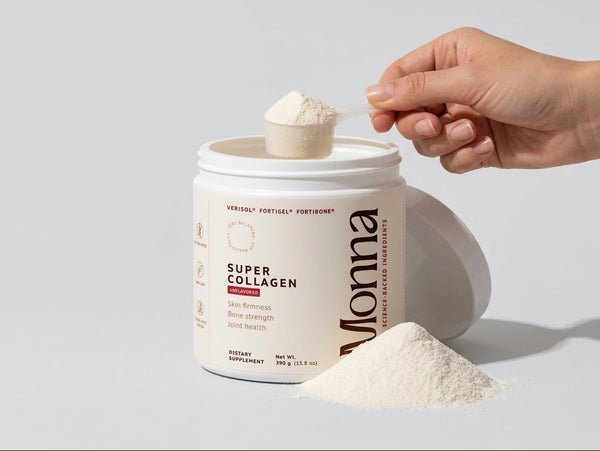
Super Collagen
Backed by 3 patented bioactive collagen peptides — built for perimenopause and menopause.