

“Bioactive” gets used loosely across the supplement industry, often as a feel-good adjective rather than a defined term. In collagen research, though, it isn’t vague at all. Scientists studying collagen peptides apply a fairly specific, three-part standard to decide whether a given peptide actually qualifies. Our post on bioactive collagen peptides covers the bigger picture of what these peptides are and how they work. This one is about the specific bar a peptide has to clear to earn that label at all.
Criterion One: It Has to Survive Digestion
The first hurdle is simple to state and surprisingly hard to clear. Most protein, once eaten, gets broken down into individual amino acids during digestion and used by the body as generic building blocks, with no ability to signal or direct specific processes. For a collagen peptide to be considered bioactive, it has to survive that digestive process largely intact, as a small peptide fragment rather than a fully broken-down amino acid.
Certain collagen-derived peptides, particularly ones containing the amino acid hydroxyproline, are structurally resistant to the digestive enzymes that would normally break them apart further. This resistance is what allows them to reach the small intestine, and eventually the bloodstream, in a form still recognizable to the body’s cells.
Criterion Two: It Has to Reach the Bloodstream Intact
Surviving digestion isn’t enough on its own. The peptide also has to be absorbed through the gut wall and appear in circulation in a form the body can actually use elsewhere. This sounds obvious, but it’s the step most collagen products have never actually been tested for.
Researchers have confirmed this step directly for at least one well-studied dipeptide, prolyl-hydroxyproline (Pro-Hyp), which has been measured in human blood following oral collagen peptide intake. This is a meaningful finding, because it moves collagen peptides from “something we ate” to “something detectable in the bloodstream,” which is the necessary bridge to any claim about effects elsewhere in the body.
Criterion Three: It Has to Trigger a Measurable Cellular Response
This is the criterion that actually earns the label “bioactive.” A peptide that survives digestion and reaches the bloodstream but does nothing once it gets there hasn’t demonstrated bioactivity. It has to interact with cells in a way that produces a measurable, testable change.
Laboratory research has shown that specific collagen-derived dipeptides can stimulate fibroblast activity and support hyaluronic acid production in skin, cartilage, and joint tissue. In one study on tendon cells specifically, a related dipeptide activated a cell-surface receptor pathway, measurably increasing both cell signaling and new collagen organization. These are the kinds of specific, testable outcomes that separate a bioactive peptide from a peptide that simply happens to be present in the body.
Why All Three Criteria Have to Be Met Together
It’s worth being clear that these three criteria aren’t a menu to pick from. A peptide that survives digestion but never shows up in the bloodstream hasn’t proven anything about its effect on the body. A peptide detected in the blood that never triggers a measurable cellular response is just a peptide passing through. Real bioactivity requires all three steps to hold up in sequence, digestive survival, absorption, and cellular activation effect, each one confirmed by its own research rather than assumed from the step before it. This is a higher bar than most collagen marketing implies, and it’s exactly why so few peptides on the market have actually cleared it.
Why Most Collagen Products Were Never Tested Against This Standard
Here’s the uncomfortable truth for a large share of the collagen market: most collagen powders on shelves today have never been tested against all three criteria as a specific, named formulation. They may be technically “hydrolyzed,” meaning broken down to some degree, without any confirmation of digestive survival, bloodstream absorption, or cellular activity for that particular product. This isn’t necessarily dishonest. It’s simply that testing a peptide against all three criteria is expensive, and most manufacturers have no incentive to do it if the word “collagen” sells just as well without the research behind it.
Patented, clinically studied peptides are different precisely because they’ve been tested against this standard, often published in peer-reviewed journals with a named ingredient, a specific dose, and measurable outcomes. This is the real, practical reason patented ingredients tend to outperform generic collagen in published research: they were formulated from the start to meet a scientific bar, not just a marketing one.
What This Means When You're Choosing a Bioactive Collagen
The next time you see “bioactive” on a label, it’s worth asking a simple question: bioactive according to what evidence? A specific, named peptide with a citation behind it has met a real, three-part scientific standard. A generic collagen blend using the word as a description hasn’t necessarily met any of them. This is exactly the kind of scrutiny we apply at Monna before anything goes into a formula, and it’s the same scrutiny we’d encourage anyone to bring to their own collagen shopping.
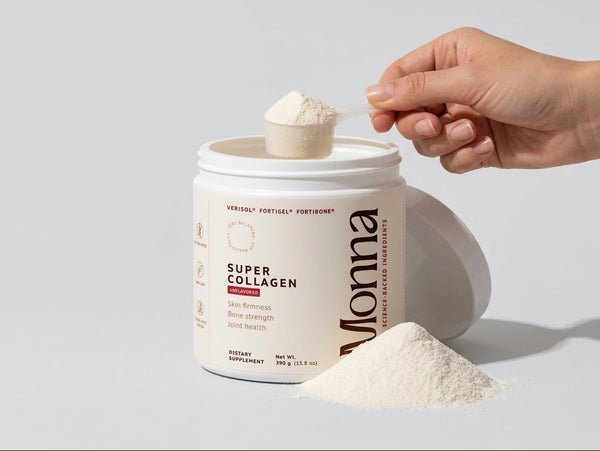
Super Collagen
Backed by 3 patented bioactive collagen peptides — built for perimenopause and menopause.