

A trustworthy collagen label names a specific, well-studied peptide, tells you exactly how much of it you’re getting, and matches that amount to real published research — most labels do none of these things.
Collagen is one of the most talked-about ingredients on the market today, and also one of the least clearly labeled. Two products can sit side by side on a shelf — one backed by real clinical studies, one filled with an unnamed, undosed collagen blend — and look almost identical to anyone just reading the front of the box. Knowing what to look for on the actual label changes that completely.
Why Most Collagen Labels Are Confusing (and Not by Accident)
The word “collagen” on its own tells you almost nothing useful. Collagen comes in many different types, from different animals, processed in different ways, and — this is the important part — studied at very different amounts across different research studies. A label that simply says “hydrolyzed collagen” or “collagen peptides,” without saying anything more specific, is giving you a category, not an actual ingredient. If you’ve read our complete guide to collagen loss in menopause, you already know why the collagen you choose matters this much. The checklist below is here to help you tell a label built on real evidence apart from one built on marketing alone.
The Checklist: What to Look for on a Collagen Label
-
A named, patented peptide — not just “collagen peptides.” Well-studied ingredients, like specific collagen peptides tested for skin, or a different specific peptide tested for bone density, are tested as an exact, repeatable formula, not as a loose category. ¹ If a label can’t name its exact peptide, chances are it can’t point you to the study behind it either.
-
A clear daily dose that matches published research. The skin studies most often cited in this space used about 2.5 grams of a specific bioactive collagen peptide each day. ² The bone density research used 5 grams a day of a different specific peptide. ³ If a label doesn’t tell you the collagen amount per serving, or it lists an amount well below these numbers, the product likely won’t give you the same results as the research it’s quietly leaning on.
-
A collagen type that matches what it claims to help. Type I and type III collagen are linked to skin, bone, and general connective tissue. Type II collagen is specific to cartilage and joint research. A joint-support product built entirely on type I collagen, for example, isn’t lined up with the tissue it says it supports.
-
Real proof of absorption, not just a source. Collagen has to be broken down into small peptides — including one called Pro-Hyp — before your body can actually absorb it into your bloodstream. Research has confirmed that these small peptides do show up in human blood after taking properly broken-down collagen. ⁴ A label that lists only “collagen,” with no mention of how it’s processed, gives you no real assurance the product is absorbable at all.
-
Clear sourcing. Bovine (cow), marine (fish), and other sources of collagen are not interchangeable, and a trustworthy label tells you which one it uses, along with basic details on where it comes from, rather than leaving “collagen source” a mystery.
-
Third-party testing. Because collagen supplements aren’t tightly regulated, independent testing for heavy metals and other contaminants is a real sign of a manufacturer’s standards, and its absence is worth noticing.
-
No proprietary blends hiding the real collagen amount. A “proprietary blend” that lists collagen next to several other ingredients, all under one combined weight, makes it impossible to know how much actual collagen you’re getting. This is one of the most common ways a label can quietly hide an under-dosed product.
What to Avoid on a Collagen Label
-
The word “collagen” with no type, source, or peptide name given.
-
No clear gram amount listed per serving.
-
Proprietary blends that group collagen with unrelated ingredients under a single combined weight.
-
Marketing language pointing to “clinical studies” without naming the specific ingredient that was actually studied.
-
A dose far below the 2.5 to 5 gram range reflected in the published research. ⁵
Bioactive Collagen vs. Generic: Why the Distinction Matters
“BIOACTIVE COLLAGEN PEPTIDES®” sometimes gets dismissed as just another marketing phrase, but it actually describes something specific and testable: a collagen that’s been broken down into pieces small enough to survive digestion, enter the bloodstream, and trigger a real response in the tissue it’s meant to support — rather than being digested the same way as any other protein we eat. ⁶ This is exactly why patented, well-studied peptides are different from generic collagen powder, even when both list “hydrolyzed collagen” on the label. The exact peptide, its size, and how it was made are what determine whether that collagen actually reaches, and works with, the tissue it’s meant to help.
How We Formulate Our Structural Collagen at Monna
Our approach to formulating anything starts with this same checklist, not the other way around: we name the specific peptides we use, we match our doses to the research those peptides were actually studied at, and we’re upfront about where our ingredients come from — because a woman navigating perimenopause and menopause deserves a label she can actually make sense of, not one she has to take on faith.
Proksch E, Segger D, Degwert J, Schunck M, Zague V, Oesser S. Oral supplementation of specific bioactive collagen peptides has beneficial effects on human skin physiology: a double-blind, placebo-controlled study. Skin Pharmacol Physiol. 2014;27(1):47–55.
² Beneficial effects of multi-micronutrient supplementation with collagen peptides on global wrinkles, skin elasticity and appearance in healthy female subjects. pmc.ncbi.nlm.nih.gov/articles/PMC11169317.
³ König D, Oesser S, Scharla S, Zdzieblik D, Gollhofer A. Specific collagen peptides improve bone mineral density and bone markers in postmenopausal women — a randomized controlled study. Nutrients. 2018;10(1):97.
⁴ Shigemura Y, Akaba S, Kawashima E, Park EY, Nakamura Y, Sato K. Identification of a novel food-derived collagen peptide, hydroxyprolyl-glycine, in human peripheral blood. Food Chem. 2011;129(3):1019–1024.
⁵ Beneficial effects of multi-micronutrient supplementation with collagen peptides on global wrinkles, skin elasticity and appearance in healthy female subjects. pmc.ncbi.nlm.nih.gov/articles/PMC11169317.
⁶ Shigemura Y, Akaba S, Kawashima E, Park EY, Nakamura Y, Sato K. Identification of a novel food-derived collagen peptide, hydroxyprolyl-glycine, in human peripheral blood. Food Chem. 2011;129(3):1019–1024.
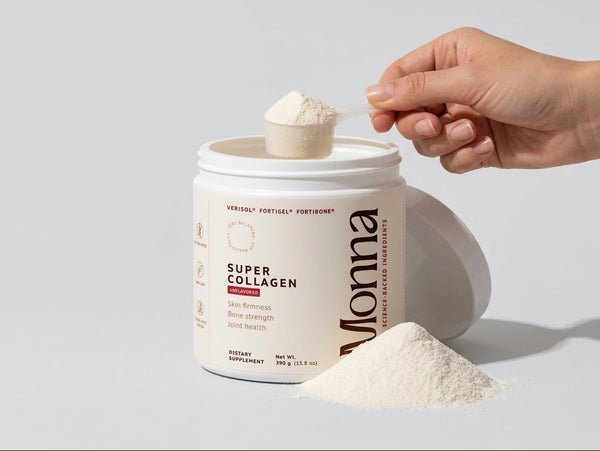
Super Collagen
Three patented bioactive peptides, research-matched doses, full transparency.